You’ve got a fresh manicure, but something feels… routine. Maybe it’s the same solid color you always reach for, or perhaps you’ve been sticking to basic stripes. You scroll through social media, admiring intricate designs, but they seem out of reach. There’s a craving for something chic, a little unexpected, yet perfectly achievable at home. You want a design that says “I put effort into this,” without actually requiring a weekend’s worth of effort. This is where the classic, yet endlessly adaptable, half moon nail art steps in. It’s an elegant twist on tradition, offering a subtle sophistication that can elevate any look, but getting those crisp, perfect crescents often feels like a gamble.
Decoding the Half Moon Manicure – A Timeless Trend Explained
The half moon manicure, also known as the “reverse French manicure,” focuses on the lunula—that pale, crescent-shaped area at the base of your nail bed. Instead of a tip, this design highlights the nail’s natural curve, often in a contrasting color or by leaving it bare for a negative space effect. It’s a design that feels both vintage and incredibly modern, depending on the colors and techniques you choose.
What Exactly Is a Half Moon Manicure?
Essentially, a half moon manicure involves painting the “half moon” area near your cuticle a different color than the rest of your nail, or simply allowing your natural nail to show through a strategic void. Imagine a regular French manicure flipped: the accent isn’t at the free edge, but at the base. This creates a clean, intentional division that can range from subtly elegant to boldly graphic. The key is the smooth, uniform curve that defines the lunula area, whether it’s painted, taped, or left unpolished.
Many professional salons offer half moon manicures, with prices typically starting around $40-60 for a gel polish version, depending on the complexity and salon location. However, with the right tools and a bit of practice, it’s a perfectly achievable DIY project at home, saving you significant costs over time.
A Brief History of the Lunula Look
The half moon manicure isn’t a new invention. Its roots stretch back to the 1920s and 30s, a period when women frequently left the lunula and the free edge of their nails unpolished, painting only the center. This look was incredibly popular, seen on screen sirens and fashion icons of the era. It was a statement of elegance and understated glamour. Over the decades, it faded and resurfaced, but never truly disappeared. Its timeless appeal lies in its simplicity and the way it subtly draws attention to the natural architecture of the nail.
Why It Remains a Popular Choice
Its enduring popularity stems from several factors. First, it offers a sophisticated alternative to a solid color. It adds visual interest without being overly complicated or flashy. Second, it’s incredibly versatile. You can pair a classic nude with a deep red, or go bold with metallic accents against a vibrant matte. Third, the half moon design can actually make your nails appear longer and more elegant, especially when using lighter colors for the lunula area. It’s also a fantastic way to experiment with color combinations without committing to a full-nail design. For instance, you could try an Essie Gel Couture polish in “Rock the Runway” (a deep red, about $13) paired with a neutral “Sheer Fantasy” from OPI (around $11) for the crescent, creating a dramatic yet refined effect.
Essential Tools and Techniques for a Flawless Crescent
Achieving that perfectly crisp, uniform crescent is the make-or-break element of a half moon manicure. While it might look intimidating, the right tools and a methodical approach make it entirely achievable. Forget shaky hands; precision is within reach.
-
The Tape Method: Precision and Clean Lines
This is arguably the most common and reliable method for creating a sharp half moon. You’ll need either specialized nail art vinyls (often from brands like Twinkled T or What’s Up Nails, typically $6-8 for a sheet of various shapes) or readily available household items. Regular Scotch tape can work, but for a truly precise curve, consider using small, circular reinforcement labels (like those used for loose-leaf paper, often under $5 for a pack of hundreds) or even cutting painter’s tape into the desired curve. For best results, ensure your base color is completely dry—and we mean completely. Apply a fast-drying base coat like Orly Bonder ($13) first, then your base color. Let it cure for at least an hour, or overnight if possible, before applying tape. Press the chosen tape or stencil firmly over your lunula, ensuring no gaps. Then, paint your contrasting color over the exposed nail. Remove the tape immediately after painting, while the second color is still wet, to prevent smudging and achieve that ultra-clean line.
-
Freehand Finesse: Mastering the Brush
For those with a steady hand and a bit of patience, the freehand method offers ultimate control and customizability. The secret lies in the brush. A fine-tipped nail art brush, sometimes called a “liner brush” or “striping brush” (you can find sets on Amazon for $10-15), is essential. After applying your base color and letting it dry fully, dip your brush into the contrasting polish, wiping off excess so it’s not overloaded. Start by creating a small dot at the center of your desired curve. Then, gently draw a smooth, continuous line from one side of the nail to the other, connecting to that central dot. You can go back and thicken the line or fill in the rest of the nail with your brush. Practice on a nail wheel or even a piece of paper first to get a feel for the curve. Brands like Zoya (around $12 per bottle) offer polishes with excellent consistency for detailed work.
-
Stencil Solutions: Quick and Consistent Results
Beyond simple tape, there are various pre-cut nail stencils designed specifically for half moon shapes. These are often made from flexible vinyl and adhere smoothly to the nail, minimizing bleed. They are a step up from basic tape, offering a wider range of curves and sizes. The application is similar to the tape method: apply a dry base coat, press the stencil firmly, paint over, and remove while wet. Some brands, like Maniology (known for stamping plates, but also offers stencils, around $7 for a sheet), provide durable, reusable options. The benefit of stencils is consistency—each nail can have the exact same curve without needing to meticulously cut tape yourself, making them a time-saver for uniform designs.
Classic Half Moon vs. Modern Interpretations
The half moon manicure is a chameleon, capable of adapting to almost any style. From its elegant, vintage roots to edgy, contemporary twists, the choice of colors, finishes, and additional details can completely transform the look. Understanding these distinctions helps you pick the perfect design for your mood or occasion.
| Feature | Classic Half Moon (e.g., “Red Carpet Ready”) | Modern Half Moon (e.g., “Geometric Edge”) |
|---|---|---|
| Color Palette | Nudes, creams, soft pinks for the lunula; deep reds, burgundies, blacks for the main nail. Often high contrast but subtle. Example: OPI “Bubble Bath” (nude pink, $11) with “Big Apple Red” (bright red, $11). | Vibrant neons, metallics, glitter, pastels, or contrasting textures. Less emphasis on “natural” colors. Example: Orly “Neon Paradise” (bright green, $10) with Zoya “Trixie” (silver metallic, $12). |
| Lunula Style | Typically a simple, single crescent following the natural curve of the nail. Often a lighter shade than the main nail. | Can feature multiple crescents, negative space (unpolished lunula), geometric shapes (triangles, squares), or even glitter accents. |
| Finish | Glossy, high-shine finish. Seche Vite Dry Fast Top Coat ($7) is a common choice for this classic sheen. | Matte, satin, or mixed finishes (e.g., matte main nail with a glossy crescent). Sally Hansen Big Matte Top Coat ($6) for a contemporary look. |
| Additional Details | Minimalist. Focus is on the clean lines and color contrast. No extra embellishments. | Can incorporate rhinestones, nail studs (e.g., small gold studs, $5 for a pack), striping tape lines, marbling within the crescent, or even tiny decals. |
| Overall Vibe | Elegant, sophisticated, vintage, timeless. Evokes old Hollywood glamour. | Bold, artistic, edgy, playful, fashion-forward. Reflects current trends and personal expression. |
When deciding between classic and modern, consider your personal style and the occasion. For a formal event, the classic pairing of a sheer pink like Sally Hansen Color Therapy “Sheer Wisdom” ($7) with a deep OPI “Lincoln Park After Dark” ($11) is always a winner. However, for a summer festival or a night out, don’t shy away from a glitter crescent using something like “Sparkle on My Soles” by Essie ($13) against a vibrant blue. The beauty of the half moon is its adaptability; it’s a versatile canvas for your creativity.
Half Moon Hacks: Troubleshooting Common Nail Art Snags
Even with the best intentions and the right tools, nail art can sometimes present unexpected challenges. A bleeding line, a smudged curve, or an uneven shape can quickly turn excitement into frustration. Here are some common problems with half moon manicures and practical solutions to keep your designs flawless.
How Do I Get a Perfectly Curved Line Every Time?
The perfect curve is often the most elusive part. Many struggle with freehand techniques, resulting in wobbly lines. The solution for consistent curves lies in leverage and tool choice. If using tape, ensure you’re using a shape that naturally fits your nail bed’s curve. Those circular hole reinforcement stickers (typically $2-3 for a pack) are excellent for this. Apply them carefully, pressing down firmly along the edges to prevent polish from seeping underneath. For freehand, anchor your painting hand on a stable surface—rest your elbow on a table, and even brace your pinky finger against your thumb or the table for extra stability. Use a very fine liner brush and paint in short, controlled strokes rather than one long, sweeping motion. Practice drawing the curve on plain paper until your muscle memory takes over. Sometimes, a tiny dotting tool (a set can be $5-10) can also help “dot” out the curve before filling it in with a brush.
Why Does My Polish Bleed Under the Tape?
This is a common and infuriating issue. The main culprit is almost always insufficient drying time for the base coat. If the base polish isn’t completely dry, the tape won’t adhere properly, creating tiny gaps for the wet polish to seep into. Give your base coat (and any subsequent layers of the base color) at least 30-60 minutes to dry thoroughly. For best results, consider letting it dry overnight. Another factor is the thickness of the polish applied over the tape. Apply thin coats. Thick polish is more likely to bleed and leave a gummy residue when the tape is removed. Press the tape down firmly with a cuticle pusher (a basic one is $5) or even a clean finger to ensure maximum adhesion, especially along the curved edge. Some low-tack tapes, like those meant for delicate surfaces (e.g., FrogTape Delicate Surface, around $8), can also minimize stickiness while still providing a good barrier.
What’s the Best Way to Fix a Smudge Without Redoing Everything?
Accidents happen. A slight smudge or a small bit of polish where it shouldn’t be doesn’t mean starting from scratch. For minor imperfections, a clean-up brush is your best friend. This is a flat, stiff brush (often sold as an “angled clean-up brush,” around $5-10) that you dip in nail polish remover. Carefully use the brush to “erase” any errant polish around your cuticle or along the half moon line. Be precise and use a light touch to avoid disturbing the main design. For very tiny specks, a wooden cuticle stick wrapped in a thin layer of cotton and dipped in remover can also work wonders. If the smudge is on the half moon itself, let it dry, then apply a tiny dab of the base color with a small brush to cover the mistake, or if it’s on the main nail, use the contrasting color. Always use an acetone-free remover for touch-ups to be gentler on your nails and prevent excessive drying.
The Simplest Half Moon Design for Beginners: A Quick Start
When you’re just starting out with half moon nail art, the goal is to build confidence without getting bogged down by intricate details or complex color theory. The absolute easiest way to dip your toes into this chic trend is by embracing negative space or a simple, sheer nude combined with a single, dark, contrasting color. This approach minimizes error points and maximizes the impact of the elegant crescent.
For your first attempt, choose a technique you feel most comfortable with – either the tape method for precision or a very careful freehand with a fine brush. Pair a clear base coat, like OPI Natural Nail Base Coat ($11), on the lunula, and then paint the rest of your nail a classic shade like Essie “Licorice” (black, $10) or OPI “Malaga Wine” (deep red, $11). The contrast is stark, the lines are clear, and the overall effect is undeniably sophisticated without requiring multiple polish colors or intricate layering. It’s a fool-proof gateway to mastering this beautiful design.
My Top Picks: Advanced Half Moon Styles for the Adventurous
Once you’ve mastered the basic half moon, a world of creative possibilities opens up. Don’t limit yourself to single colors and simple curves. I firmly believe that the most striking half moon designs come from layering textures, playing with geometry, and incorporating unexpected elements. These advanced techniques require a bit more precision and possibly a few more tools, but the payoff is a truly unique and eye-catching manicure that will turn heads.
Glitter Gradients and Dual Crescents
One of my favorite advanced techniques is the glitter gradient half moon. Instead of a solid color, create a subtle fade from a dense glitter near the cuticle to sparse glitter further up the nail. You can achieve this by applying a glitter polish, like Zoya “Godiva” (a textured gold, $12), to a sponge and dabbing it onto the lunula area, building up the intensity. For a “dual crescent” look, use two different shades for your half moon, one slightly smaller and layered over the other. For example, paint a wider crescent in a soft pastel like Orly “Gumdrop” ($10), then layer a thinner, metallic crescent over it using something like Essie “Good as Gold” ($10). This adds depth and visual intrigue without being overly complicated. It’s a fantastic way to introduce more dimension to your manicure.
Geometric Plays and Unexpected Textures
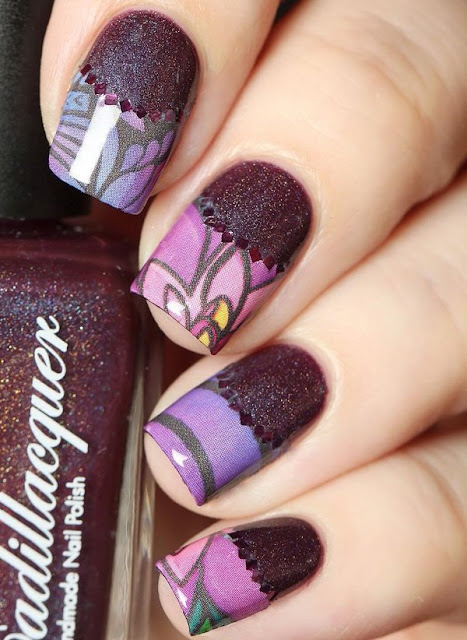
Move beyond the traditional curve by opting for geometric half moons. Instead of a rounded lunula, use striping tape (available in various widths, often $5 for a multi-pack) to create a sharp V-shape, a triangular cut-out, or even a small square at the base of your nail. These angular designs offer a modern, edgy twist. Try a matte base polish, like Manucurist Green Nail Polish “Dark Pansy” ($19), with a glossy, metallic V-shape in Sally Hansen Insta-Dri “Silver Stallion” ($6). The contrast in finish adds an extra layer of sophistication. Another bold choice is to incorporate textured polishes. A sand-effect polish or even a velvet top coat (from brands like OPI, $11) can transform a simple half moon into a tactile experience. Imagine a smooth, glossy main nail with a textured, matte black half moon—the visual and physical contrast is captivating.
Layering and Intricate Details
For those truly adventurous, consider adding intricate details within the half moon itself. This could involve painting tiny dots (with a dotting tool, $5 for a set) or micro-stripes within the crescent using a contrasting color. A delicate lace pattern or a small floral decal (nail art decals are often $3-7 for a sheet) can also be placed carefully within the lunula area before sealing with a top coat. You can also play with negative space even further by creating a half moon, then adding a small, unpolished dot within the polished crescent, effectively creating a “dot within a dot” effect. These require a very fine detail brush and a steady hand, but they elevate the design from simply painted nails to miniature works of art. A quick-dry top coat like Seche Vite ($7) is crucial for sealing these detailed designs effectively and preventing smudges.
Curating Your Half Moon Palette: Polish & Finish Choices
The success of any half moon nail art design hinges significantly on your choice of polishes and finishes. It’s not just about the colors; the formula, opacity, and final sheen can dramatically alter the impact and longevity of your manicure. Thinking beyond just “red” or “nude” will unlock a broader spectrum of possibilities.
-
Understanding Different Polish Formulas
Not all polishes are created equal. For intricate designs like half moons, polish consistency matters. “One-coat wonders” (often thicker, like Sally Hansen Insta-Dri, about $6) can be challenging for fine lines but great for quick full coverage. Cream polishes (like many from Essie or OPI, $10-13) are typically opaque and offer smooth application, making them versatile. Sheer polishes (e.g., OPI “Bubble Bath” or Manucurist Green Nail Polish “Nude”) are excellent for negative space half moons or for a softer, more subtle contrast. Gel polishes (like Madam Glam or Beetles Gel Polish, $8-15 for a set) offer unparalleled durability and shine but require a UV/LED lamp. For precise work, choose polishes with a medium, self-leveling consistency; avoid anything too thick or too watery, which can bleed.
-
Matte vs. Gloss: The Impact on Your Design
The finish of your polish can be just as impactful as the color itself. A classic half moon typically features a high-gloss finish, which enhances the vibrancy of the colors and creates a sophisticated sheen. Brands like OPI and Essie offer excellent high-shine top coats (e.g., Essie Gel Setter, $13). However, a matte finish can transform a design, giving it a modern, velvety appearance. Imagine a vibrant glossy half moon against a deep, matte main nail. The contrast in textures is visually striking and adds an unexpected dimension. You can achieve this with specific matte polishes or by applying a matte top coat (e.g., Orly Matte Top Coat, $13) over any glossy polish. A “satin” finish, which is somewhere between matte and gloss, offers a softer, more understated elegance.
-
Top Coat Selection: Longevity and Shine
Your top coat is the final, crucial step. It seals your design, adds shine (or matte effect), and protects against chips and wear. For a glossy finish, “quick-dry” top coats like Seche Vite Dry Fast Top Coat ($7) are popular for their speed and glass-like shine, but some users find they can shrink over time. Alternatively, “plumping” top coats (e.g., OPI Plumping Top Coat, $11) give a gel-like look without the lamp. For matte looks, a dedicated matte top coat is essential. Consider non-yellowing formulas if you’re working with light colors. Always apply a generous but not excessive amount of top coat to ensure full coverage of your design, including the edges, which helps prevent chipping.