Most people think thrift store chic is about luck. You walk in, dig through racks, and hope something decent turns up. That approach works about 10% of the time. The other 90%, you leave empty-handed or with a polyester nightmare you’ll never wear.
There’s a better way. This article lays out a repeatable, step-by-step system for building a cohesive capsule wardrobe from secondhand sources — for under $100 total. Think of it as a legal framework: you need rules, evidence, and a clear verdict before you spend a dime.
The Myth of Random Luck: Why Most Thrift Hauls Fail
The single biggest mistake new thrifters make is shopping without a plan. They walk in with no list, no color palette, and no idea what their wardrobe actually needs. The result is a pile of mismatched items that never get worn.
Courts don’t let juries deliberate without a framework. You shouldn’t shop without one either.
Here’s what goes wrong when you thrift without structure:
- No color palette. You buy a neon green top because it’s cute, but nothing in your closet matches it. It sits in your drawer for 18 months and then goes to donation.
- No fit standards. You grab a blazer that’s “close enough” on size. It bunches at the shoulders and makes you look sloppy. You never wear it.
- No fabric criteria. You buy a polyester dress that looks good on the hanger but pills after one wash and feels clammy in humidity.
- No budget cap. You spend $15 on four random items that don’t coordinate, instead of $40 on two high-quality pieces that work together.
The fix isn’t complicated. You need three things before you walk through the door: a defined color palette, a list of specific garment types, and a hard dollar limit per piece. This isn’t legal advice — it’s just common sense — but treating it like a case file makes it stick.
Step 1: Define Your Color Palette (The Rule of 3-2-1)
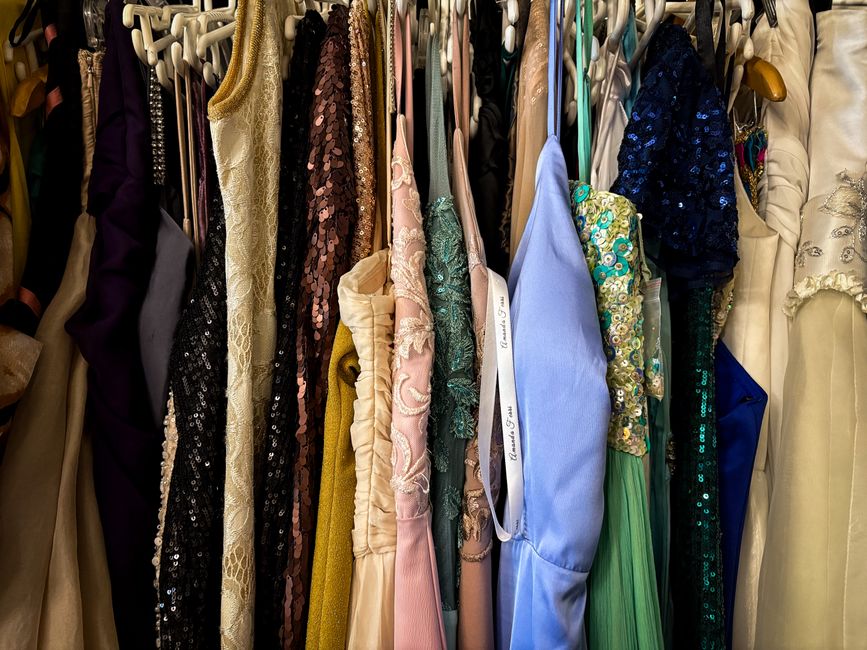
Before you touch a single hanger, decide your palette. This is the single highest-leverage decision you’ll make. A tight palette makes every piece look intentional, even if it cost $4.
The 3-2-1 rule works for any gender or style:
- 3 neutrals — these do the heavy lifting. Black, navy, charcoal, cream, olive, or camel. Pick three that work with your skin tone.
- 2 accent colors — these add personality without chaos. Think burgundy, mustard, forest green, dusty rose, or rust.
- 1 wildcard — a statement color or pattern you love. Bright cobalt, leopard print, or a floral that includes two of your accent colors.
Write these down on your phone or a scrap of paper. Every item you consider buying must match at least two colors in your palette. If it doesn’t, put it back.
For example: a neutral palette of charcoal, cream, and olive with accents of rust and mustard, plus a leopard print scarf as the wildcard. Every top, bottom, and layer you buy must work with at least two of those colors. That’s the rule.
Step 2: The 7-Piece Capsule Blueprint
A capsule wardrobe isn’t about owning 30 items. It’s about owning the right 7 that create 20+ outfits. Here’s the exact list you’re shopping for:
- One structured blazer or jacket — this is the anchor piece. Look for wool blends, tweed, or cotton twill. Avoid polyester. Brands to hunt: J.Crew, Banana Republic, Brooks Brothers, vintage Harris Tweed.
- Two tops — one neutral (white, cream, or black) and one in an accent color. Look for 100% cotton, silk, or linen-cotton blends. Check the tags. Avoid anything labeled “one-size-fits-most.”
- Two bottoms — one pair of jeans or trousers in a dark neutral, and one in a lighter neutral or accent. For jeans, Levi’s 501 or Wrangler are everywhere in thrift stores and hold up. For trousers, look for Banana Republic or Ann Taylor in wool or cotton blends.
- One dress or jumpsuit (optional but recommended) — a simple shift dress in a neutral color works with the blazer, both tops, and both bottoms. Look for Lands’ End or LL Bean for durable cottons.
- One layering piece — a cardigan, sweater, or vest. Cashmere blends from J.Crew or Nordstrom brands show up frequently. Check for holes and pilling before buying.
That’s 7 items. Total budget: $100. That leaves about $14 per piece on average. In a good thrift store, that’s realistic. You’ll find blazers for $8–12, tops for $4–6, jeans for $6–10, and dresses for $8–12.
Step 3: The Evidence Standard — How to Inspect a Garment Like a Legal Investigator
You wouldn’t accept a witness’s testimony without cross-examination. Don’t accept a thrift store garment without inspection either. This takes 90 seconds per item.
| Checkpoint | What to look for | What to reject |
|---|---|---|
| Fabric label | Cotton, linen, wool, silk, Tencel, modal, or blends with at least 60% natural fiber | 100% polyester, acrylic, nylon (unless it’s a specific vintage piece you love) |
| Seams and stitching | Straight seams, no loose threads, double-stitched at stress points (armholes, crotch, side seams) | Single-stitched seams, puckering, visible unraveling |
| Zippers and buttons | Zipper moves smoothly, buttons are all present and match | Stuck zipper, missing buttons, mismatched buttons |
| Stains and damage | Small stains in non-visible areas (inside hem) can be fixed. Holes in seams can be repaired. | Large stains on front panels, heavy pilling, frayed cuffs or collars, underarm discoloration |
| Fit check (waist, shoulder, length) | Shoulder seam aligns with your shoulder bone. Waist hits at your natural waist or where you prefer. Hem length works for your height. | Shoulder seam more than 1 inch off, waist too tight or too loose by more than 2 inches, hem that can’t be altered easily |
Pass an item through all five checkpoints? It goes in the cart. Fail any one? Put it back. This is non-negotiable.
One exception: if a piece is nearly perfect but needs a minor alteration (hemming pants, taking in a waist), and the alteration cost is under $15, it’s still a good deal. Factor that into your per-piece budget.
Step 4: Where to Shop and When to Walk Away
Not all thrift stores are equal. You need to know which ones serve your case — and when to bail.
- Goodwill — best for basics and denim. Inventory varies wildly by location. Go to stores in wealthier neighborhoods for higher-quality donations. Visit Tuesday–Thursday mornings for the best selection before weekend crowds clear it out.
- Salvation Army — similar to Goodwill but often has better blazers and outerwear. Check the men’s section for oversized blazers that work as women’s oversize jackets.
- Buffalo Exchange or Crossroads Trading — curated secondhand. Prices are higher ($10–25 per item) but quality is screened. Good for filling specific gaps in your capsule when you’re short on time.
- Estate sales and church thrift stores — underrated. Estate sales often sell high-quality vintage pieces for $2–5. Church thrift stores are smaller but priced lower than Goodwill.
When do you walk away empty-handed? If you’ve been in the store for 45 minutes and haven’t found a single item that passes the evidence standard. Do not buy something just because you drove there. The sunk cost of the trip is gone. Buying a bad piece only adds regret.
On average, you’ll find 1–3 capsule-worthy items per trip to a well-stocked Goodwill. If you find zero, that’s normal. Try a different location next time.
Step 5: The Alterations That Turn a $8 Blazer Into a $200 Blazer

This is the step most people skip, and it’s the difference between “that looks thrifted” and “where did you get that blazer?”
Three alterations are worth every penny:
- Hemming pants. Most thrift store trousers are too long. A basic hem costs $10–15 at a dry cleaner. It transforms the look completely. Do this for every pair of trousers you buy.
- Taking in the waist. Blazers and dresses often fit in the shoulders but are loose in the body. A tailor can take in the side seams for $15–20. This is cheaper than buying a new blazer and gives you a custom fit.
- Replacing buttons. Swapping cheap plastic buttons for matte brass or tortoiseshell buttons costs $5 in materials and 20 minutes of work. It upgrades any blazer, coat, or cardigan instantly.
Budget $20–30 total for alterations on your 7-piece capsule. That brings your total investment to $120–130, which is still under what you’d pay for one fast-fashion blazer that falls apart in six months.
One more tip: learn to sew a button and hem a simple straight line by hand. YouTube has tutorials that take 10 minutes. You’ll save $50 a year in dry cleaner fees.
Step 6: The Final Verdict — What a Complete $100 Capsule Looks Like
Here’s a real example from a recent thrift run in a mid-sized city. All items were found within 90 minutes across two Goodwill locations and one Salvation Army.
| Item | Brand | Fabric | Price | Alteration cost |
|---|---|---|---|---|
| Charcoal wool blazer | Banana Republic | 60% wool, 40% polyester | $10 | $15 (waist taken in) |
| White cotton button-down | J.Crew | 100% cotton | $6 | $0 |
| Rust linen-blend top | Everlane | 55% linen, 45% cotton | $5 | $0 |
| Dark wash straight-leg jeans | Levi’s 501 | 100% cotton | $8 | $0 |
| Olive cotton twill trousers | Lands’ End | 100% cotton | $7 | $10 (hem) |
| Navy cotton shift dress | LL Bean | 100% cotton | $9 | $0 |
| Cream cashmere-blend cardigan | J.Crew | 70% cashmere, 30% nylon | $12 | $0 |
| Total | $57 | $25 |
Total outlay: $82. That leaves $18 in the budget for a pair of shoes or a bag from a secondhand source. With those 7 pieces, you can create 22 distinct outfits by mixing and matching. Each outfit costs less than $4 to assemble.
Compare that to buying one new fast-fashion blazer for $60 that won’t last the season. The math isn’t close.
The verdict: Thrift store chic isn’t about luck. It’s about having a system. Define your color palette. Know your 7 pieces. Inspect every item like a legal investigator. Spend $20 on alterations. Walk away if the evidence doesn’t hold up. Follow this framework, and you’ll build a wardrobe that looks intentional, costs under $100, and lasts years longer than anything new from a mall.