Here’s a number that stings: a 2026 survey by YouGov found that 62% of women over 40 felt their clothing made them look older than they actually are. Not their skin. Not their hair. Their clothes.
The problem isn’t age. It’s a handful of specific, fixable mistakes that date your silhouette, dull your complexion, and signal “I stopped updating my style years ago.”
I’ve spent the last decade styling women in their 30s through 60s, and I can tell you: the same five errors show up again and again. Here they are — and exactly how to fix each one.
The Oversized Blazer Trap (And Why It Backfires)
Oversized blazers have been trendy for five years straight. But here’s the catch: on most women over 35, a boxy, shoulder-padded blazer does the opposite of what you want. It hides your waist, broadens your upper body, and makes you look like you’re borrowing a jacket from a larger friend.
The problem is proportion. As we age, we naturally lose some muscle mass and definition. An oversized shape exaggerates that loss, making you look smaller inside the fabric rather than confidently draped.
What to wear instead: A blazer that nips at the waist or has a defined shoulder. The Everlane The Italian Stretch Blazer ($198) has a subtle hourglass cut without being tight. The Uniqlo IDLF Blazer ($129) is another option — it has soft shoulders and a gentle waist seam that creates shape without structure.
If you love the oversized look, limit it to one layer. Wear a fitted top underneath and cropped trousers to show your shape elsewhere. The moment you pair an oversized blazer with wide-leg pants and a loose blouse, you’ve created a tent.
Necklines That Close You Off
This is the single fastest way to add five years. A crewneck sweater that sits right at your collarbone. A turtleneck that’s too tight. A button-down shirt buttoned to the top.
Why does this matter? Because the neck and décolletage area naturally shows signs of aging — sun damage, crepiness, loss of elasticity — and covering it completely draws attention to the fact that you’re covering it. It reads as hiding.
The fix is a V-neck or a scoop neck. A V-neck creates a vertical line that lengthens the neck and draws the eye downward. It also exposes a triangle of skin that reflects light, brightening your face.
Specific picks: The Madewell Whisper Cotton V-Neck Tee ($35) is a no-brainer — it’s soft, not sheer, and the V is deep enough to flatter but not plunge. For sweaters, the J.Crew Tissue Turtleneck ($68) works because it’s thin and loose, not thick and choking. If you love a crewneck, layer a collared shirt underneath and leave the top two buttons open.
One more rule: if the neckline touches your Adam’s apple area, it’s too high. You want a gap of at least two fingers between fabric and throat.
The Wrong Denim Wash and Rise
Denim ages you faster than any other item in your closet. Not because of the fabric, but because of the specifics.
Three mistakes dominate:
- Dark, stiff, rigid denim with no stretch. It looks like a uniform, not clothing. It creases at the hips and knees in unflattering ways.
- Ultra-low-rise jeans (anything below the hip bone). These create a muffin top on almost every body type and expose the belly area that most women want to minimize.
- Heavy whiskering and fading — those white lines across the thighs and knees. They date the jeans to 2007 and draw attention to your widest points.
What works: A mid-rise (sitting at or just below the navel) with 1-2% elastane for comfort. A straight or slim-straight leg. Minimal distressing.
The Levi’s Wedgie Straight Jeans ($98) are a cult favorite for a reason — they have a 10.5-inch rise, a straight leg that doesn’t swallow your shoes, and a subtle stretch that holds shape. The Everlane The Way-High Jean ($98) has an 11-inch rise and comes in a rigid denim that softens after three washes.
If you’re over 45, consider a trouser-style jean — a flat front, a crease down the leg, and a slightly wider hem. It reads as intentional and polished rather than “I’m trying to wear what my daughter wears.”
Fabric That Screams “Cheap”
Fabric is the silent age-giver. You can have the perfect cut, the right color, the ideal length — but if the fabric is wrong, you’ll look tired and dated.
The worst offenders:
- Stiff polyester blouses that don’t breathe. They trap heat, cause static, and have an unnatural sheen that reflects light unevenly.
- Acrylic sweaters that pill after two wears. Pilling makes any garment look like it’s been in a drawer since 1999.
- Rayon challis — it wrinkles instantly and looks limp by noon.
What to look for instead: Natural fibers or high-quality blends with at least 50% natural content. Cotton, linen, wool, silk, and Tencel all age gracefully. They soften over time rather than pilling.
Specific recommendations: The Eileen Fisher Silk Crepe Tee ($168) is expensive but lasts years — it drapes beautifully, doesn’t wrinkle, and washes by hand easily. For a budget option, Uniqlo’s 100% Cotton Tees ($15) are thick enough to not be sheer and hold their shape through 30+ washes. The Reformation Linen Shirt ($128) has a relaxed fit that looks intentional, not sloppy.
One test: grab the fabric and squeeze it in your fist for 10 seconds. If it springs back without wrinkles, it’s good. If it stays creased, put it back on the rack.
Color Choices That Drain Your Face
This is the most subjective mistake, but also the most fixable. The wrong color next to your face makes you look sallow, tired, or washed out — regardless of your skin tone.
The colors that age most people: beige, gray-brown, dull navy, and off-white that’s closer to cream than pure white. These colors lack contrast and absorb light rather than reflecting it.
The fix is contrast and saturation. You want colors that have clear pigment — true red, rich emerald, cobalt blue, crisp white, deep black. These colors create a boundary between your face and your clothing, which makes your skin look clearer and brighter.
A few specific swaps:
- Instead of beige, try cream or ivory. Everlane’s Cashmere Crew in Bone ($168) is warm without being yellow.
- Instead of gray, try charcoal or slate. Uniqlo’s Merino V-Neck in Dark Gray ($50) has enough depth to work as a neutral.
- Instead of faded black (which reads as gray), wear true black or a dark navy. COS’s Wool-Blend Turtleneck ($135) comes in a black that stays black after washing.
If you’re unsure, hold a white piece of paper next to your face in natural light. If the paper makes your skin look brighter, you need more contrast in your wardrobe.
Shoes That Kill Your Silhouette
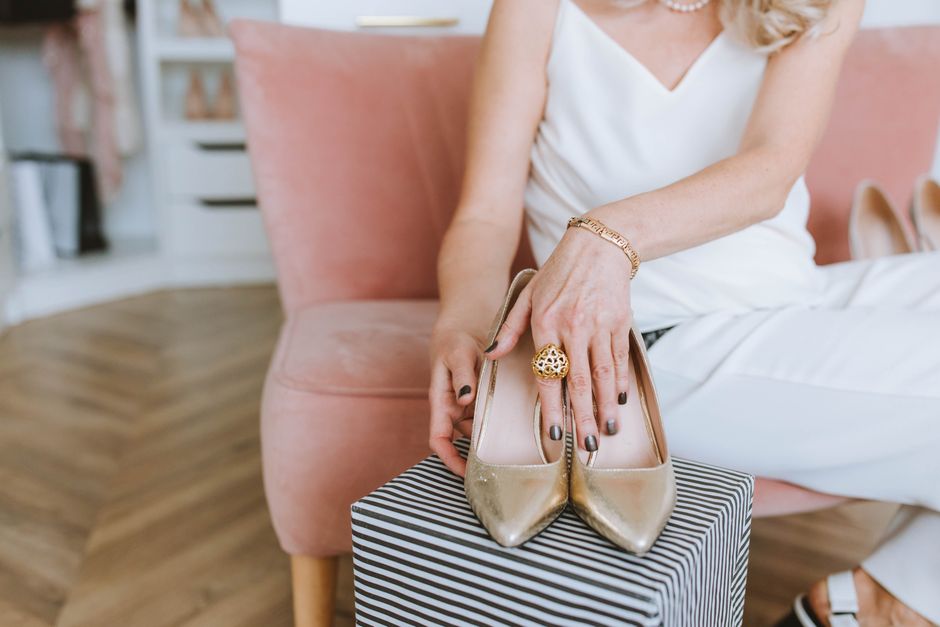
Shoes are the foundation of every outfit, and the wrong pair can undo everything above them.
The most common aging shoe mistake: a chunky, square-toed flat or a sneaker with a thick, orthopedic-looking sole. These shoes add visual weight to your feet, shorten your legs, and make your stride look heavy.
What works better: A shoe with a pointed or almond toe, a low heel (1-2 inches), or a streamlined silhouette. The pointed toe elongates the leg line, even in a flat.
Specific picks: The Madewell The Frances Flat ($128) has a pointed toe and a cushioned insole — it’s comfortable for all-day wear but looks polished. The Sam Edelman Hazel Pump ($120) has a 1.5-inch block heel that’s walkable and adds a subtle lift. If you need sneakers, the Veja V-10 ($155) has a slim profile and a clean white that doesn’t look like a medical device.
One rule: if you can see the sole from a standing position, the shoe is too chunky. You want the sole to be no thicker than 1.5 inches at the heel.
How to Find Your Real Style After 35
Most fashion advice for “dressing younger” is actually advice for dressing like a 22-year-old. That’s not the goal. The goal is to look like the best version of yourself — current, confident, and comfortable.
Here’s a framework that works:
- Identify three words that describe how you want to feel in clothes. Examples: polished, relaxed, creative. Use those words as filters when shopping.
- Audit your closet for the mistakes above. Remove anything with pilling, fading, or a neckline that’s too high. Be ruthless — if you haven’t worn it in a year, it’s gone.
- Invest in three core pieces that solve multiple problems. A well-fitted blazer, a quality pair of jeans, and a white silk top can carry 80% of your outfits.
- Get a tailor. A $20 alteration on a $100 blazer makes it look like a $500 blazer. Hemming pants, taking in a waist, shortening sleeves — these are cheap fixes that transform fit.
The brands that consistently deliver for this purpose: Everlane for basics with clean lines, Uniqlo for affordable quality, Madewell for jeans that fit real bodies, and COS for architectural pieces that don’t follow trends.
You don’t need to spend a lot. You need to spend smart. A single $150 blazer that fits perfectly will do more for your style than ten $30 blazers that don’t.